Offer a reaching opportunity without moving the baby's body into a result
A baby can explore movement while an adult offers an appropriate object and watches. The useful role is creating a safe opportunity, not making the hands complete a milestone. A simple setup also makes it easier to notice what the baby does naturally and to describe concerns accurately to the care team.
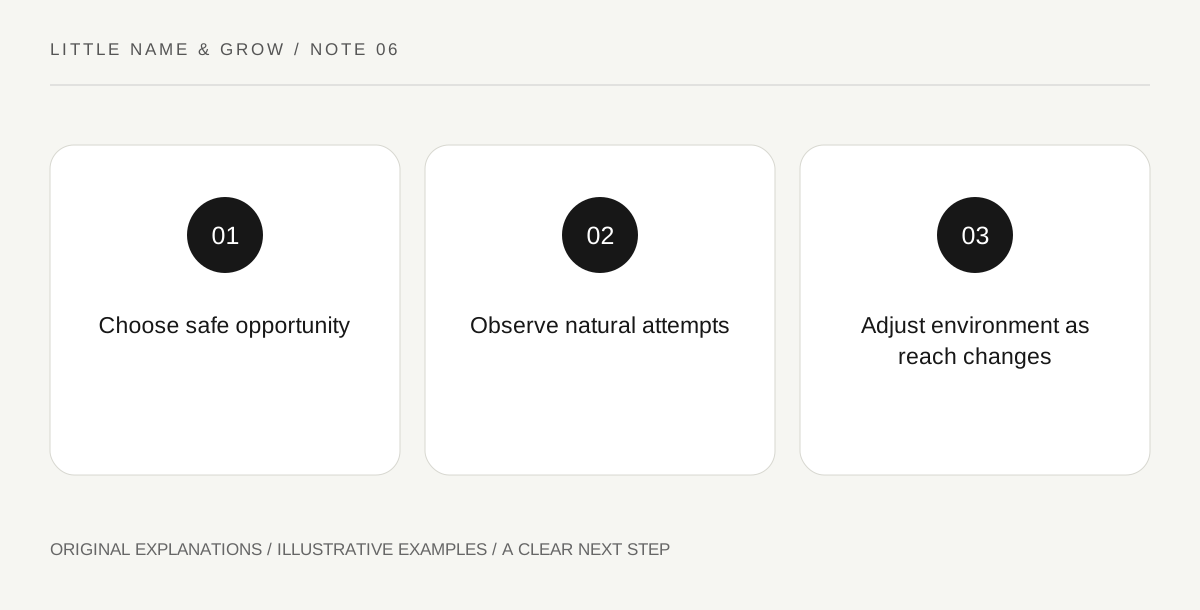
Original explanatory diagram. Read the full method and limitations below.
Choose a stage-appropriate opportunity
Use current developmental guidance and the baby's individual care plan to choose a suitable awake play position. AAP describes reaching and movement as part of ordinary baby activity. The object should be intended for the baby's stage, intact and free of small parts, cords or other hazards. Do not use household objects merely because they are colorful. Keep supervision active and the surface appropriate. An activity for a baby who can sit independently may not fit one who cannot. This guide does not assign a universal reaching test or determine readiness from chronological age alone.
Make one object available clearly
Offer a suitable object in a way that allows the baby to attend and move, following professional guidance where needed. Avoid crowding the space with many competing toys. You can use your voice and face naturally without repeatedly commanding reach. Do not pull the baby's arms, place fingers around the object to manufacture success or hold the body in an unsupported position for a photograph. A natural attempt can include looking, moving or no immediate response. The point is exploration within an appropriate setup, not producing the exact adult-defined action at the first invitation.
Choose an object you can remove easily when the baby is no longer interested. An elaborate suspended setup may be less practical than one appropriate item under supervision, and any product must be used within its instructions. Keep cords and attachments outside the baby's reach as required. The opportunity is valuable because the baby can explore appropriately, not because the adult has created the most visually impressive play area.
Watch the process rather than only contact
Notice what the baby attends to, which movements occur and whether the setting seems comfortable. Keep observations ordinary and factual. A missed object does not prove a problem, and a single successful grab does not establish complete developmental progress. If you notice persistent concerns, an unusual pattern or loss of a skill, discuss them with the clinician. Do not create harder tests or increase repetition to obtain certainty. A short account of the position, object and response is more useful than a label such as weak coordination chosen from an online video.
Keep the environment ahead of new movement
As reaching develops, objects previously out of reach can become accessible. Review nearby small items, hot drinks, cords and other hazards rather than waiting for a dramatic new skill. Follow product instructions and current child-safety guidance. Play objects should not migrate into the sleep space as a way to encourage practice overnight. Store them appropriately after use. The useful outcome is a safe opportunity and an attentive adult, with room for the baby to explore. Developmental support does not require a larger toy collection, constant coaching or a promise that a particular activity accelerates motor skills.
An illustrative single-object play
During suitable awake supervised play, a parent offers one intact stage-appropriate toy. The baby looks and moves without immediately grasping it. The parent observes rather than repositioning the hands for success, then checks the surrounding area for newly reachable hazards as movement changes.
Practical checks
Optional checkboxes save only in this browser.
Questions that come up
Should I place the toy in the hand to prove the skill?
That changes what is being observed. Offer an appropriate opportunity and discuss concerns rather than manufacturing a result.
Does a missed reach diagnose delay?
No. A single attempt is not an assessment. Bring persistent concerns to the care team.
References and scope
These sources support the factual background. Examples and exercises are original illustrative teaching material. References do not imply endorsement.
- AAP: Baby Activity — Supervised age-appropriate movement, reaching and play.
- CDC: Milestones by Six Months — Age-linked observations and responsive play; checklists do not replace screening.