Leave a turn in the conversation before your baby has words
Talking to a baby is not a performance of constant narration. A pause can make room for a look, movement or sound that you can notice and respond to. The aim is a responsive shared moment, without treating early sounds as a test or promising that a particular script accelerates language.
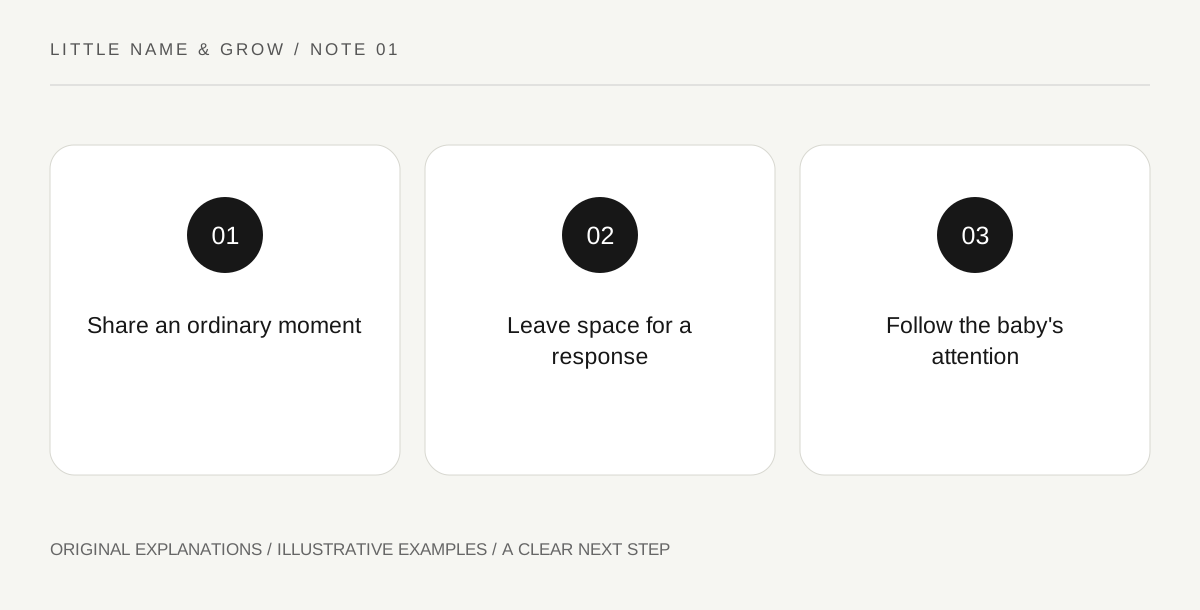
Original explanatory diagram. Read the full method and limitations below.
Begin with an ordinary shared moment
Choose a time when the baby is awake and reasonably settled, while you can give appropriate attention. A diaper change or looking at a familiar object can supply something to talk about without a special lesson. AAP describes babies' interest in human voices and early sound exchanges. Use natural words about what is happening rather than reading a compulsory script. Keep necessary care central; a conversation does not justify leaving a baby unsupported or turning a routine task into an extended teaching session. A short welcome exchange is enough when either person is ready to stop.
Invite another regular caregiver to describe an exchange they enjoyed, without comparing who gets the biggest reaction. A baby may respond differently with different voices and at different times. The shared information can be simple: a familiar phrase, a pause and a moment of attention. Keep the focus on the relationship rather than a tally of vocal turns. A caregiver who speaks less fluently in the household's main language can still offer natural interaction in a language they know.
Say something and allow a pause
Offer a simple phrase, then wait rather than filling every gap. A baby's response may be a facial expression, a movement or a sound, and it may not arrive on cue. Notice the actual response without inventing an intention. You can reflect a sound or comment on what the baby attends to. The pause is an opportunity, not a demand that the baby perform. Avoid repeatedly prompting until a camera captures the desired result. If attention moves away, follow that information. Responsive interaction is different from testing how many sounds can be produced during a fixed interval.
Keep voice and face accessible
Position yourself appropriately so the baby can see and hear you comfortably, following any relevant care guidance. Reduce unnecessary competing sound when practical instead of speaking louder over several devices. Use the language and voice that feel natural to you. Do not hold a phone in a way that interferes with safe care or blocks the interaction. A recording may preserve a memory, but it is not required for a useful exchange. If you have concerns about hearing, vision or communication, discuss them with the baby's clinician rather than using a successful or unsuccessful conversation as a home diagnostic test.
Notice patterns without scoring the baby
Remember a few ordinary examples if you want to discuss development: a sound during a familiar game or attention to a voice. Keep the age, setting and what you observed separate from your interpretation. Do not compare one baby with a sibling's edited video or expect every day to look the same. Seek appropriate advice about concerns or loss of skills. The goal is enjoying and supporting communication while leaving assessment to qualified professionals. A quiet moment can still be meaningful; the baby does not need to produce a new skill for the interaction to count.
An illustrative clothing-change conversation
While changing a settled baby's clothes safely, a parent names a sleeve and pauses. The baby looks toward the parent's face and makes a sound. The parent responds briefly, then continues care. The exchange is not timed, repeated for a video or recorded as proof of advanced language.
Practical checks
Optional checkboxes save only in this browser.
Questions that come up
Should I talk continuously to support language?
No. Natural responsive exchanges can include pauses and quiet. Follow the baby's attention and comfort.
Can one sound prove development is on track?
No. A single exchange is not a screening or diagnosis. Discuss concerns with the care team.
References and scope
These sources support the factual background. Examples and exercises are original illustrative teaching material. References do not imply endorsement.
- AAP: Hearing and Making Sounds — Responsive talking and early vocal communication.