When play becomes fussier, reduce the inputs before adding another activity
A busy interaction can include several voices, music, lights and repeated attempts to entertain. If the baby becomes fussier, adding another toy may not help. A practical pause simplifies the setting and checks ordinary care needs, without diagnosing overstimulation or assuming every cry has the same explanation.
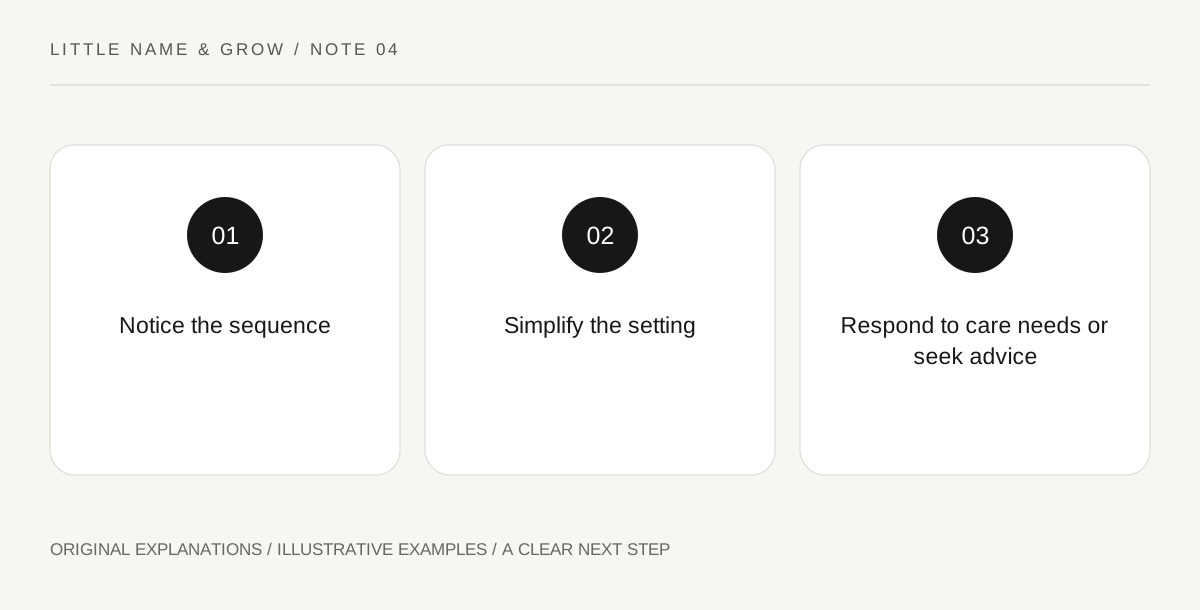
Original explanatory diagram. Read the full method and limitations below.
Describe what changed in the interaction
Notice the setting, activity and sequence before the fussiness. Did several people begin talking, did the baby become tired or did a routine need attention? AAP's soothing guidance recognizes that too much stimulation can be relevant, but a caregiver cannot identify every cause from one signal. Keep the description factual. Turning away or crying is information to respond to, not proof that the baby dislikes a particular person. Avoid filming repeated reactions to demonstrate a theory. If the behavior is unusual, persistent or concerning, seek appropriate care rather than continuing to test the environment.
Reduce one avoidable input
Lower or stop optional music, put aside the flashing toy or ask the group to let one adult interact at a time. Keep necessary awareness and supervision. A quieter setting does not require complete silence or a special sensory product. Hold or place the baby safely according to the situation and relevant instructions. Do not introduce a new soothing technique every few seconds; rapid switching can make the experience harder to interpret. The aim is making the moment simpler, not proving that an exact sound level or room color controls the baby's nervous system.
Check ordinary needs and the care plan
Consider feeding, a diaper change, temperature comfort, tiredness or another relevant need, following the baby's care instructions. Do not assume a calm-looking environment rules out illness or pain. A feeding or medical concern needs the appropriate professional route rather than a generic calming routine. Avoid adding unverified remedies, weighted products or sleep-positioning items because the baby seems hard to settle. A pause should preserve safe care, including a suitable sleep arrangement if the baby is ready to sleep. The adult's interpretation remains provisional; the task is responding appropriately to the baby now.
Resume only if the interaction is welcome
If the baby settles and appears interested, try a simpler exchange. If not, meet the current care need or seek advice as appropriate. No play session has to be completed. Tell other caregivers what you observed without assigning blame or a permanent label such as sensitive baby. A brief account of the setting and response can help the next adult. The useful result is a more manageable moment and a clear next step, not a guaranteed soothing method. Persistent crying or a caregiver feeling unable to cope deserves support rather than increasingly elaborate entertainment.
If several adults are present, ask one to manage optional noise and another to support the responsible caregiver's practical needs. That is different from several people simultaneously trying to soothe. A simpler division can make it easier to notice what happens next. Keep the baby with the appropriate responsible adult and avoid abrupt transfers merely to test a theory. The result may be no immediate improvement, which is a reason to consider the next care or advice step.
An illustrative family gathering
At a gathering, several relatives talk while a musical toy plays. The baby becomes fussier. A parent safely takes responsibility, stops the optional toy and checks ordinary needs. They do not pass the baby rapidly between adults to see who can stop the crying or label the episode a diagnosis.
Practical checks
Optional checkboxes save only in this browser.
Questions that come up
Does fussiness prove overstimulation?
No. Several needs or health concerns can cause fussiness. Treat the idea as one possibility, not a diagnosis.
Should I keep trying toys until one works?
Avoid rapid escalating changes. Simplify, respond to care needs and seek help for persistent or concerning crying.
References and scope
These sources support the factual background. Examples and exercises are original illustrative teaching material. References do not imply endorsement.
- AAP: Calming a Fussy Baby — Responding to fussiness and avoiding overwhelming simultaneous soothing attempts.
- AAP: Responding to Your Baby's Cries — Responding to crying, safe caregiver pauses and never shaking a baby.