Make space for the languages your baby's caregivers actually use
A multilingual home does not need to sound like a language course. Familiar adults can speak naturally while providing ordinary responsive care. A useful family discussion concerns who communicates with the baby and how, without treating a heritage language as a problem or using multilingualism to dismiss a genuine developmental concern.
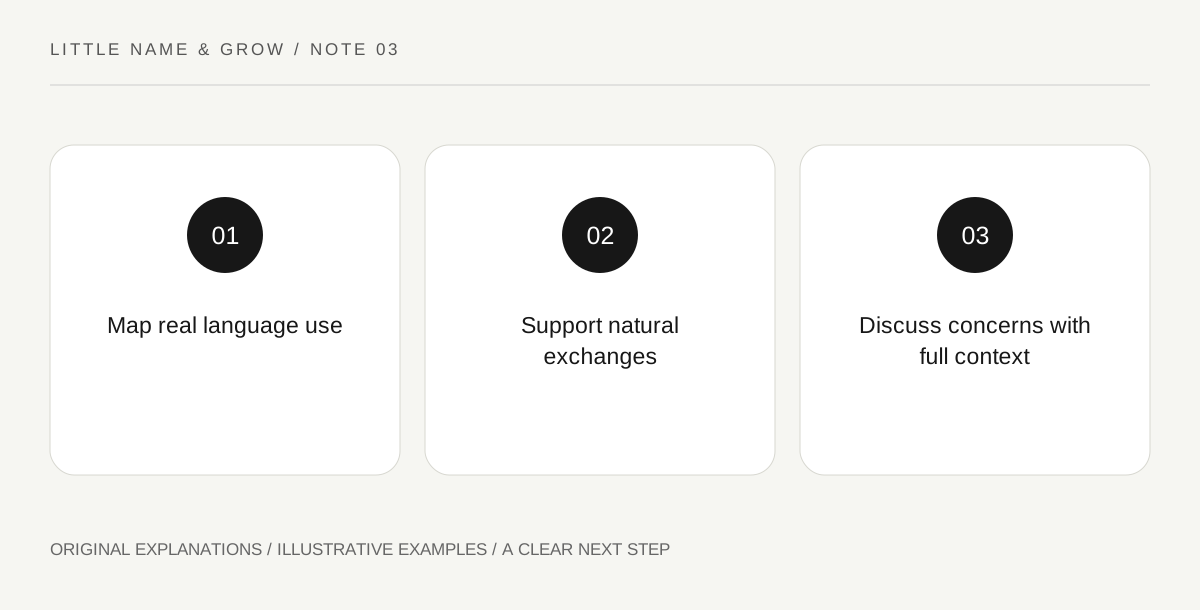
Original explanatory diagram. Read the full method and limitations below.
Map the real communication environment
List the languages used by parents, relatives and regular caregivers, including the settings in which they are comfortable. AAP explains that children can learn multiple languages and addresses common myths. Avoid assigning every person a rigid role merely because a method is popular online. A grandparent may naturally use one language, while a parent uses more than one depending on the situation. The map describes actual relationships rather than a competition over equal minutes. Keep access needs, including hearing support or signed communication where relevant, in the professional conversation instead of assuming all family communication is spoken.
Use natural interaction rather than constant translation
Talk, sing or share an appropriate book in a language you know well. A responsive exchange is more useful than a caregiver straining through a memorized script they cannot comfortably extend. You do not need to translate every sentence immediately for the baby. Adults can agree on practical care information in a language they share while using their own languages during interaction. Keep treatment and safety instructions accurately understood across caregivers; a casual translation is not enough for a medically significant direction. Ask the care team for appropriate language support when necessary.
Keep language exposure separate from diagnosis
If you are concerned about hearing, communication or lost skills, tell the clinician about the languages and situations in which the baby communicates. Do not assume multilingual exposure explains every concern or that removing a language is the automatic solution. Equally, one unfamiliar response in one setting does not diagnose a delay. Bring concrete observations rather than comparing with an online child. A qualified professional can consider the full communication environment. The family map helps make that environment visible; it is not a test, a vocabulary quota or proof that a particular pattern is best for all children.
Write the language map as a description that can change, not a contract assigning ownership of the baby's learning. Work hours, visits and care arrangements may alter exposure. Share a relevant change with a professional if it helps explain communication observations. Avoid measuring affection through language minutes. The goal is understandable, natural contact and appropriate assessment when needed, not an exactly equal distribution that becomes difficult for the adults to maintain.
Support caregivers without creating a contest
Invite relatives to use comfortable language and ordinary routines, while respecting the family's actual arrangements. Avoid correcting accents as if one adult's voice is less valuable. If a caregiver wants a shared phrase for a routine, write it with a clear meaning and ask a knowledgeable speaker to check it. Keep the child's name and preferred family forms accurate without demanding identical pronunciation in every language. The useful goal is accessible, affectionate communication across relationships. It does not require early fluency promises, a perfect one-person-one-language rule or a public record of which caregiver contributes the most.
An illustrative family map
A baby hears one language from a grandparent and two from the parents. The adults describe that environment to the clinician when asking a communication question. At home they use natural stories and care routines rather than timing equal language blocks or dropping the grandparent's language on an unsupported assumption.
Practical checks
Optional checkboxes save only in this browser.
Questions that come up
Must every family use one person, one language?
No universal rule is prescribed here. Choose a workable pattern and seek relevant professional advice when needed.
Should a concern be ignored because the baby hears two languages?
No. Bring specific observations and the full language environment to an appropriate assessment.
References and scope
These sources support the factual background. Examples and exercises are original illustrative teaching material. References do not imply endorsement.
- AAP: Young Children Learning Multiple Languages — Multilingual family communication and avoiding myths that delay appropriate support.
- NIDCD: Baby Hearing Screening and Next Steps — Screening results and timely professional follow-up.