Use a phonetic name note without confusing it with the spelling
A pronunciation note can help a willing caregiver learn a child's name, but its notation needs to be understood. Ordinary respelling, a sound recording and International Phonetic Alphabet symbols do different jobs. A useful note labels its method and scope rather than claiming that one improvised spelling represents every accent.
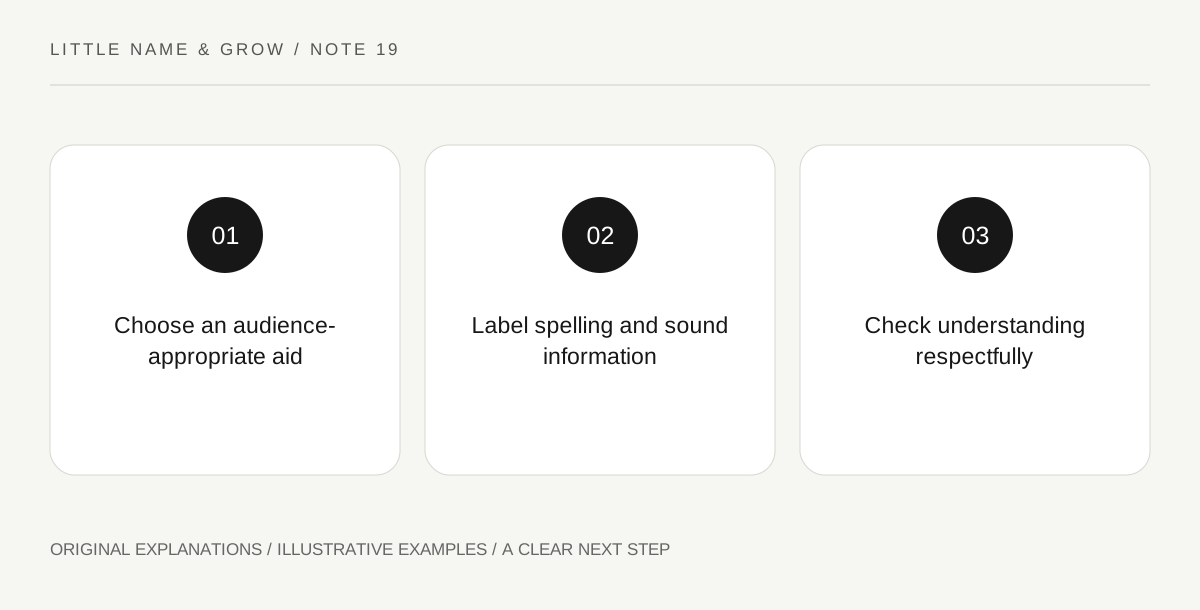
Original explanatory diagram. Read the full method and limitations below.
Decide who the note is for
A grandparent, childcare worker and language specialist may need different information. Ask what format would be useful rather than providing a technical transcription nobody can read. Keep the child's identifying details limited to the actual purpose. A short spoken model from an authorized adult can be useful in a private appropriate channel, while a plain-language cue may be enough. The name's official written form should remain separate. A pronunciation aid is not an alternative legal spelling or a reason to replace the child's name with an easier unrelated form without the family's agreement.
Label ordinary respelling honestly
A cue such as an emphasized syllable in capitals is a personal teaching aid, not a universal alphabet. The same English-looking syllable can be pronounced differently by different readers. State whose intended pronunciation the cue describes and check whether the recipient understood it. Avoid asserting that a rhyme works in every accent. If the name comes from a language you do not know, consult knowledgeable speakers or an appropriate language source rather than constructing an authoritative-sounding pronunciation from letters alone. A family preference can be stated clearly without claiming to represent every speaker of a language.
Recognize what IPA adds and what it does not
The International Phonetic Association provides a standardized chart of sound symbols. IPA can make a pronunciation description more precise when the writer and reader know the system, but it is not ordinary spelling and does not choose the correct family pronunciation. A transcription still needs a source, language context and appropriate expertise. Do not copy symbols from a vaguely similar name and present them as verified. If a professional or reliable source supplies a transcription, retain its context. This article does not invent an IPA version of a child's name or require parents to learn a full phonetics course.
Keep a sound recording short and purposeful if you choose one, and ask the receiving service how it should be shared and retained. A name pronunciation clip does not need a birth date, address or family story attached. Check that it plays clearly without requiring a public profile. The privacy arrangement is part of making an aid useful; the most precise description is not automatically the best format for every recipient.
Check understanding through a respectful exchange
Offer the note, let the person try if willing and correct the relevant part gently. A brief private exchange is often more useful than a public pronunciation test. Allow agreed language-specific variation where the family is comfortable with it. Keep the child's own preferences open as they grow. Update the note if it creates more confusion than it solves. The useful outcome is an accessible aid attached to the chosen name, not a claim that every person must produce an identical accent or that a technical symbol string can replace listening and respectful communication.
An illustrative caregiver note
Parents make a private note with the child's written name and a clearly labeled family pronunciation cue. A caregiver finds the respelling ambiguous, so they ask for a brief spoken model. The parents do not label their improvised capitalized syllables as IPA or treat the cue as a replacement spelling.
Practical checks
Optional checkboxes save only in this browser.
Questions that come up
Is a capitalized respelling the same as IPA?
No. It is an informal aid whose interpretation can vary. IPA is a defined symbol system requiring appropriate knowledge.
Does IPA decide the family's correct pronunciation?
No. It can describe sounds, but the intended pronunciation and language context still need a reliable source.
References and scope
These sources support the factual background. Examples and exercises are original illustrative teaching material. References do not imply endorsement.
- International Phonetic Association: IPA Chart — A standardized sound-symbol resource, distinct from ordinary spelling.