Keep full name, display name and sorting order as separate questions
A family name record may need to support a full written form, an everyday display and an alphabetical list. Those purposes are related but not identical. Separating them avoids assuming that the first word is always a given name or that a software-generated abbreviation describes the family's intended use.
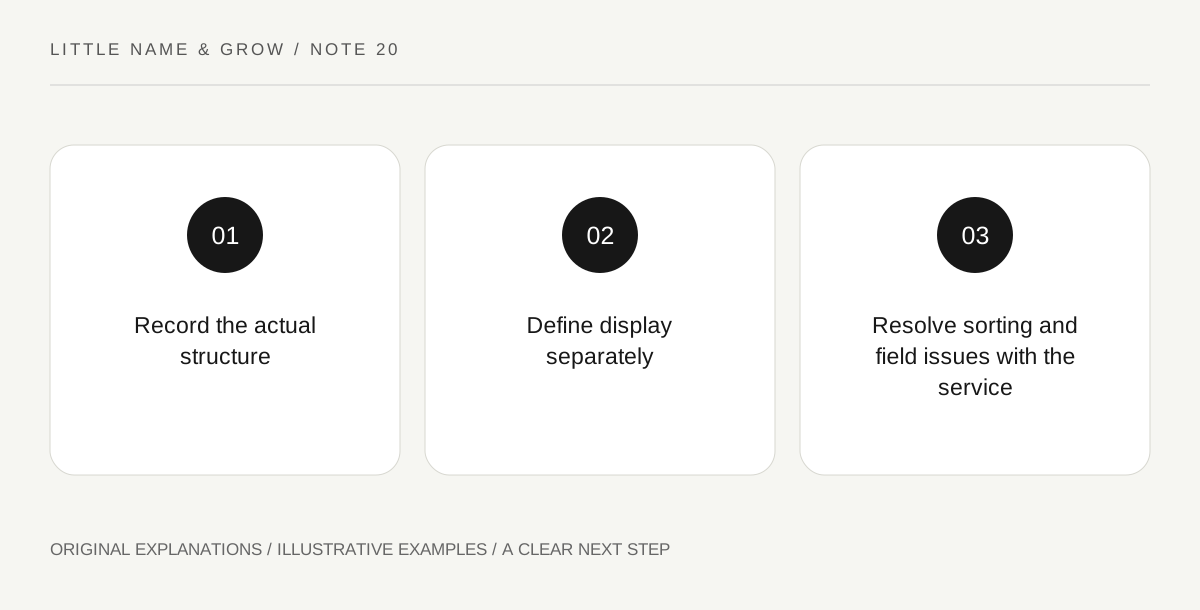
Original explanatory diagram. Read the full method and limitations below.
Start with the family's actual name structure
Write the full intended form and ask knowledgeable family members how its elements function. W3C's internationalization guidance explains that personal-name structures and ordering vary, including within countries. Do not force every name into an assumed first-middle-last pattern. A space may separate parts of one given name or parts with another role. Keep the family's explanation distinct from the requirements of a particular official form. This guide concerns a practical private reference, not a legal determination. Official records and registration systems must be handled according to their own current instructions.
Define the display purpose
An everyday label may use a chosen form, while an official document requires a full authoritative form. Ask what a caregiver or organizer needs and share only that information. Do not let a program automatically shorten a multi-part name because it assumes the last word is the preferred everyday form. A display choice should be deliberate and reversible where the service allows it. Keep a preferred form clearly labeled rather than overwriting the full reference. This can help adults communicate accurately without turning every social situation into a demand for the child's complete identifying information.
Treat sorting as a separate convention
An alphabetical list needs a rule, but that rule does not determine how the person is addressed. Ask the organization how it sorts and whether the record can preserve the correct display. Do not infer a family name from position alone or assume every family member must share the same surname. W3C highlights the limits of simplistic data fields. A sorting workaround should remain attached to the system and purpose. It should not silently become the family's new spelling, an invented middle name or a claim that the original structure is wrong.
Document mismatches without improvising identity changes
If a system cannot represent the name clearly, contact the responsible service and ask about supported fields, notes or correction routes. Preserve what was entered and what was displayed without sharing unnecessary personal documents. Do not submit invented components simply to satisfy a required field without official guidance. A private reference can list full form, intended display and the system-specific issue separately. The useful outcome is accurate communication across purposes, with limitations visible. It does not guarantee that every platform or authority accepts the same characters, ordering or field arrangement.
Test a private record with fictional examples before entering identifying information into an unfamiliar tool. Check whether the tool silently reorders, abbreviates or drops elements on export. A display that looks correct in one view may change on a label or list. If that happens, keep the original structure and ask the service about the output rather than inventing a new name component to satisfy an assumption.
An illustrative family reference
A fictional family keeps the full written name and a separately agreed everyday display. A club's list sorts the name unexpectedly, so the parent asks the organizer about its convention rather than rewriting the full form. The sorting issue remains a system question, not a decision about what the child should be called.
Practical checks
Optional checkboxes save only in this browser.
Questions that come up
Is the first word always the given name?
No. Name structures and order vary. Ask about the actual name rather than assuming from position.
Does an alphabetical sorting rule determine how to address someone?
No. Sorting and preferred address serve different purposes and should be kept distinct.
References and scope
These sources support the factual background. Examples and exercises are original illustrative teaching material. References do not imply endorsement.
- W3C: Personal Names Around the World — Name structures and order vary; data fields can impose misleading assumptions.