Use an ancestor's record as evidence of a spelling, not proof of a name's origin
A family document can show how a name was recorded in a particular place and time. It may not establish the person's preferred form, the spelling at birth or a linguistic meaning. A careful research note keeps image, transcription and interpretation separate before using an ancestral name as inspiration.
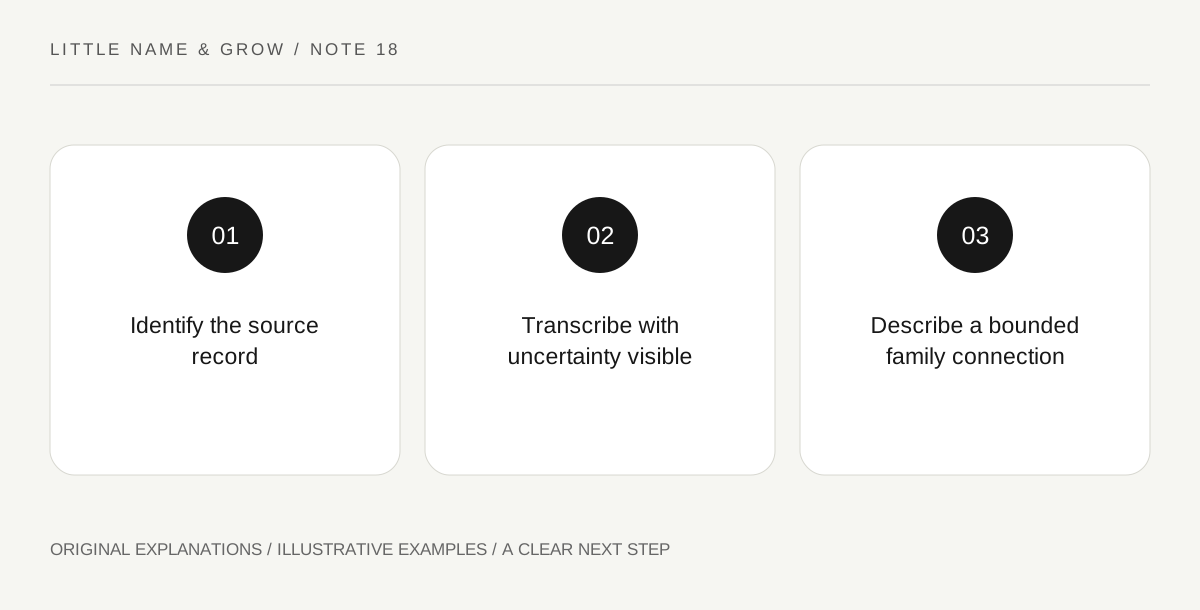
Original explanatory diagram. Read the full method and limitations below.
Identify the record before copying the name
Write the record type, date, place and archive reference. A census entry, a signature and a later index have different relationships to the person named. The National Archives notes that catalog descriptions may omit individual names and that variant spellings can matter in research. A search result is therefore a route to evidence, not always the evidence itself. Seek the original image or reliable reproduction when available. Do not assume the first indexed spelling is the only form used or that a record belongs to your ancestor merely because the name looks familiar.
Keep transcription separate from interpretation
Copy what you can read and mark uncertainty rather than silently modernizing a letter. Compare other handwriting on the page if that helps, while avoiding a confident guess presented as fact. A bracketed note or question mark can preserve an unresolved reading. Keep the image and your transcription together privately where appropriate. If a family member supplies a remembered spelling, record that as a separate source. The goal is not to force every document into one perfect string. Different records can reflect spelling variation, transcription error or genuinely different people, and the evidence needs to distinguish those possibilities.
Record whether a name is a signature or was entered by another person when the source makes that clear. Those are different kinds of evidence about preferred use. Do not assume a census spelling was chosen by the person named, or that a signature alone establishes the form used in every context. A careful note can preserve both observations without making either carry more historical certainty than it supports.
Use variants as search hypotheses
Search plausible variants, initials or other known details using the archive's current tools and guidance. A variant is a research aid, not proof that all matching records describe one person. Compare dates, places and relationships through appropriate evidence. Do not publish private living-person information to obtain help with a naming choice. Ask an archive or knowledgeable researcher when the record is difficult. A family story can remain meaningful while its historical details are uncertain. The research task should preserve that uncertainty rather than invent a migration explanation or etymology to make the name more appealing.
Write an honest naming connection
If the record inspires a baby-name candidate, describe the actual connection: this spelling appears in a particular family document, or this is the form a relative remembers. Keep that separate from a literal meaning or a claim of ancient uninterrupted use. You can choose an adapted form while acknowledging the adaptation. The decision does not require settling every genealogical question. Save a short source note for the child if desired, with privacy respected. The useful outcome is a truthful family link supported within its scope, not a polished origin story assembled from a single uncertain handwritten entry.
An illustrative archive note
A fictional family finds a handwritten form that may read Marta or Martha. They save the record reference, mark the uncertain letter and compare other evidence before identifying the person. If they use a related baby name, they explain the family inspiration without claiming that the record proves its etymology.
Practical checks
Optional checkboxes save only in this browser.
Questions that come up
Does an index prove the original spelling?
Not necessarily. An index is a transcription or description with its own limits. Consult the underlying record when available.
Can a meaningful family story admit uncertainty?
Yes. State what is known and what remains uncertain instead of inventing a more definite history.
References and scope
These sources support the factual background. Examples and exercises are original illustrative teaching material. References do not imply endorsement.
- National Archives: Using the Catalog — Variant name spellings and the limits of catalog descriptions for family research.