Use a simple back-and-forth game without turning it into a milestone exam
A familiar game can become an exchange when the adult pauses and notices the baby's response. It does not need a dramatic laugh or a new skill every time. A useful approach keeps the game safe, simple and responsive, while leaving developmental assessment separate from whether a baby enjoys one activity today.
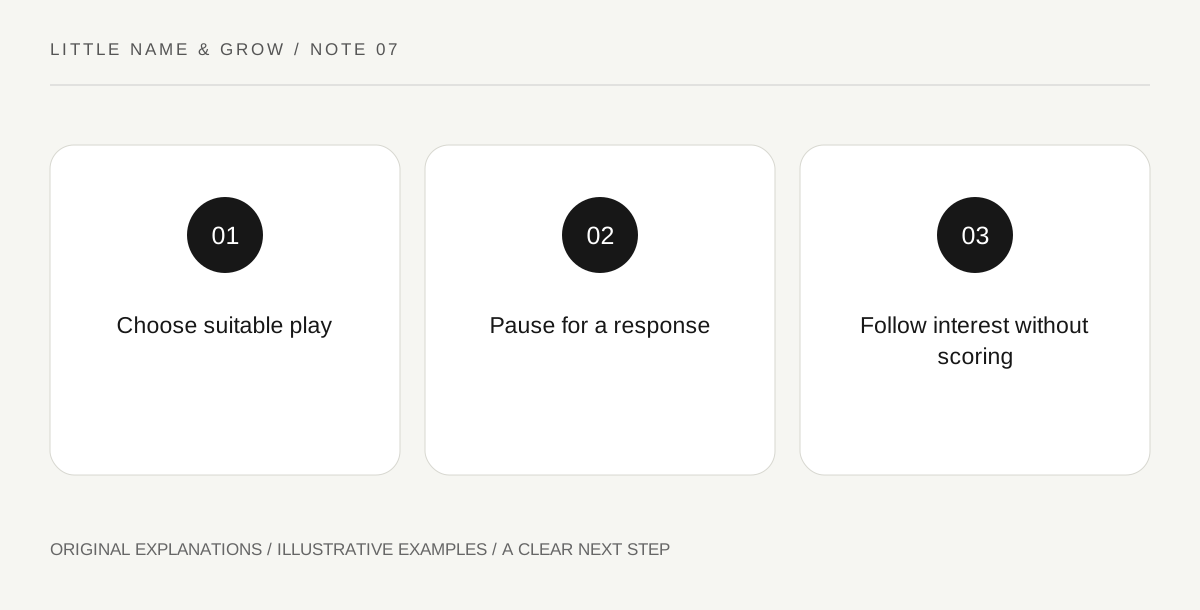
Original explanatory diagram. Read the full method and limitations below.
Choose a game that fits the baby's stage
Use age-appropriate ideas from reliable developmental resources and the baby's care guidance. CDC's milestone pages include examples of play and interaction while distinguishing them from validated screening. A simple face or voice game may fit without equipment. Avoid placing cloths or objects over a baby's face, creating a choking hazard or using sudden frightening movements to provoke a response. Keep the baby safely supported in an appropriate awake setting. The adult's role is supervision and interaction, not demonstrating a universal cognitive test. Different babies can prefer different activities at the same age.
Make the pattern predictable enough to join
Use a short familiar sequence and a pause. Notice whether the baby looks, smiles, vocalizes or turns away. Respond to the actual signal rather than repeating faster to obtain the reaction you expected. You can stop after a brief exchange. A game does not need to continue until the baby laughs, and an adult's enjoyment should not override the baby's comfort. Keep other noise and competing activity manageable where practical. The point is a shared pattern that can be noticed, not a lesson that must be completed exactly as a video demonstrates.
Avoid reading too much into one response
A baby may react differently when tired, hungry, distracted or unwell. A successful game does not certify a developmental stage, and a quiet response does not establish a delay. Keep concerns in the broader pattern of play, communication and movement. If something worries you, describe it to the clinician with age and context. Do not repeatedly hide objects or surprise the baby to test an online theory about object permanence. A family activity should remain responsive play. Formal screening and assessment have different purposes and methods, and an internet challenge cannot replace them.
Teach the game to another adult through its stopping cues as well as its beginning. Explain that turning away, fussiness or a care need changes the plan. A relative may otherwise think the task is to obtain a laugh at any cost. A shared understanding can preserve a gentle familiar pattern without demanding identical performance. The activity remains optional and responsive, with the baby's state more important than completing the sequence.
Let other caregivers learn the baby's preferences
Share a useful observation such as enjoys a short familiar phrase and then a pause, rather than an instruction that everyone must use the same game. A new caregiver can begin gently and allow familiarity to develop. Keep the activity separate from sleep and feeding needs. If the baby is no longer interested, move to the relevant care task. The useful outcome is a simple way to interact that respects changing attention. It does not require buying a developmental toy, recording a performance or comparing the baby's reaction with another child's edited highlight.
An illustrative game adjustment
A grandparent starts a familiar face-and-voice game during awake supervised time. The baby looks briefly and then turns away. The grandparent pauses and ends the activity rather than escalating the surprise to obtain laughter. The family treats the response as information about the moment, not a developmental score.
Practical checks
Optional checkboxes save only in this browser.
Questions that come up
Does enjoying a game prove a milestone is complete?
No. A single enjoyable interaction is not a validated screening or diagnostic assessment.
Should I keep surprising a quiet baby until they laugh?
No. Follow comfort and attention rather than demanding a particular reaction.
References and scope
These sources support the factual background. Examples and exercises are original illustrative teaching material. References do not imply endorsement.
- CDC: Milestones by Nine Months — Observing play and communication and discussing developmental concerns.
- CDC: Developmental Monitoring and Screening — Everyday monitoring differs from standardized screening and diagnostic assessment.