Let an unfamiliar adult become familiar without demanding a smile
A baby's response to a new face can vary with age, tiredness and the setting. A useful introduction allows the trusted caregiver to remain involved and the baby to respond at their own pace. It does not label a quiet or upset baby unfriendly or make physical contact a requirement for pleasing adults.
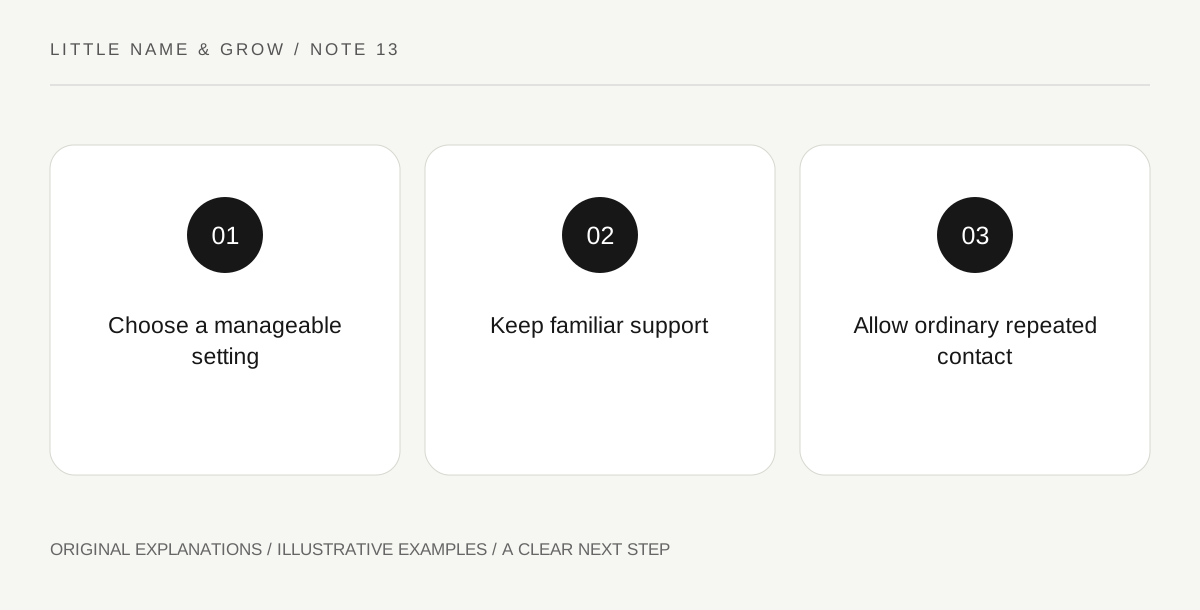
Original explanatory diagram. Read the full method and limitations below.
Choose the moment and keep expectations modest
Consider whether the baby is tired, hungry, unwell or already managing a busy setting. AAP describes changing responses to unfamiliar people during later infancy. That does not give a fixed age at which every baby should behave the same way. Keep the first interaction simple and optional. A relative's long journey or excitement does not create a duty for the baby to smile or be held immediately. Necessary care and family health precautions still apply. If the response is unusual or part of a broader concern, discuss it with the clinician rather than assigning a personality label.
Let the unfamiliar adult contribute through another appropriate role if holding is unwelcome. They can talk with the parent, help with a household task or share a suitable book while the trusted caregiver remains involved. This preserves the relationship without making the baby's immediate response the measure of the visit. Adults can build familiarity over time while respecting health precautions and the baby's changing state.
Keep a familiar caregiver involved
Let the new adult begin through a calm voice or an ordinary shared activity while the trusted caregiver remains appropriately close. Do not pass the baby rapidly around a group to see who can win them over. Follow safe handling and the family's actual care arrangements. The purpose is familiarity, not a test of attachment. A new caregiver who will later provide care can learn the baby's cues and routines through an appropriate gradual introduction. That process should include the necessary care information and authorization, separate from whether the baby responds warmly during the first few minutes.
Follow the baby's signals without blaming anyone
If the baby turns away, clings or cries, pause and respond to the need. Do not interpret the reaction as proof that the adult is bad with children or that the parents caused a problem. Avoid escalating voices, surprise or touch to force a cheerful result. A quieter interaction or another time may fit better. Keep the description factual: the room was busy and the baby became upset after a transfer. That is more useful than calling the baby spoiled or antisocial. The adult can remain welcoming without treating a smile as a social obligation.
Build familiarity through repeated ordinary contact
A short suitable visit, familiar song or shared routine may be more manageable than a grand introduction. Keep the baby's sleep, feeding and health needs central rather than extending the visit to obtain a particular response. If a care transition is planned, ask the relevant professionals or service about support when needed. The useful outcome is a respectful opportunity for familiarity, not a guarantee that separation or stranger-related distress disappears. A baby's response can change across days. Adults can accept that variability while maintaining safe, reliable and affectionate care.
An illustrative relative visit
An aunt meets a baby during a quiet awake period while a parent remains involved. She speaks gently and waits rather than requesting an immediate handover. When the baby turns away, the adults pause. They plan another ordinary visit without treating the missing smile as a judgment about the relationship.
Practical checks
Optional checkboxes save only in this browser.
Questions that come up
Does reluctance mean the baby dislikes the person?
Not necessarily. Age, state and setting can affect the response. Avoid interpreting one moment as a permanent judgment.
Should everyone hold the baby to build confidence?
No. Follow the baby's comfort, safe care and the family's arrangements rather than forcing contact.
References and scope
These sources support the factual background. Examples and exercises are original illustrative teaching material. References do not imply endorsement.
- AAP: Emotional and Social Development, Eight to Twelve Months — Unfamiliar people and separation can affect babies' responses.