A milestone checklist starts a conversation; it does not give a diagnosis
Parents can notice development every day, while a standardized screening or diagnostic assessment has a different role. Understanding that distinction makes a checklist more useful and less like a scorecard. A concern deserves discussion even when an app looks reassuring, and one unchecked item does not establish a condition.
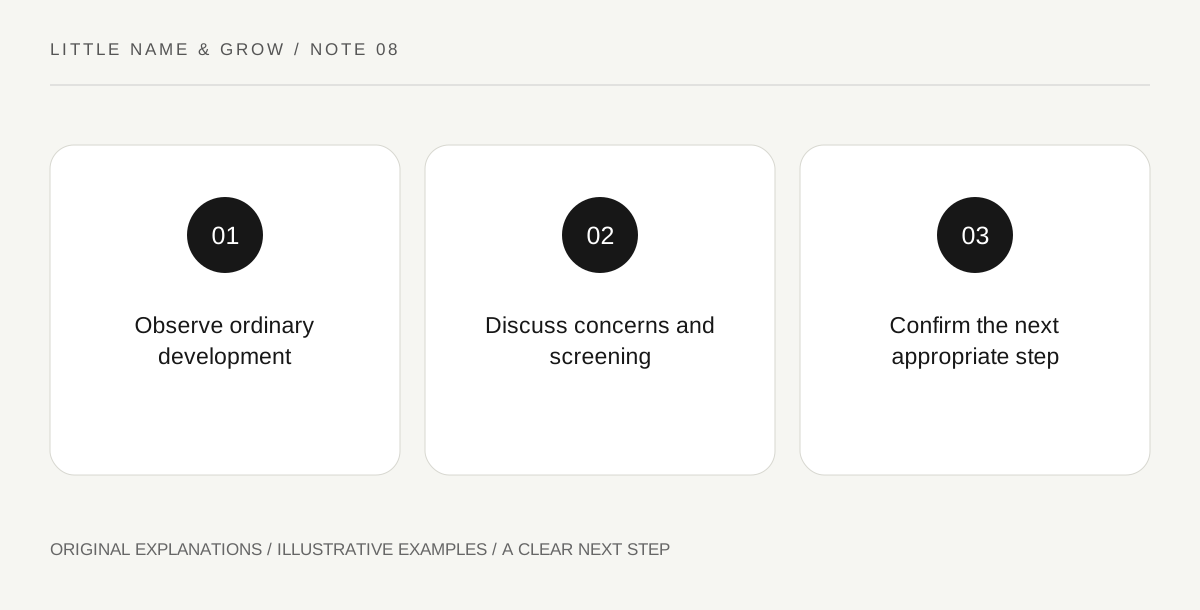
Original explanatory diagram. Read the full method and limitations below.
Use monitoring to describe ordinary life
CDC defines developmental monitoring as noticing how a child grows and changes over time. Parents and other regular caregivers can contribute observations about play, learning, communication and movement. Use the checklist relevant to the child's age and circumstances, with care-team guidance when needed. Write what you have actually seen rather than repeatedly staging a test. The record can include uncertainty. Not sure yet is more honest than marking a skill complete because a relative remembers something similar. Keep the baby's full pattern visible rather than reducing development to one favorite item or an app's completion percentage.
Recognize what screening adds
CDC distinguishes more formal developmental screening using validated tools from everyday monitoring. A screening can identify a need for further evaluation, but it is not the same as a diagnosis. Ask the care team when and how screening is offered and how concerns can be raised between routine visits. Do not assume a consumer tracker performs that function simply because it uses medical-looking language. A polished interface can organize observations without validating an assessment. Keep the source and purpose of each tool clear, especially when results from different ages or tools appear to disagree.
Bring concerns without waiting for perfect evidence
Describe the concern, when you noticed it and how it appears in daily life. Mention loss of a previously used skill promptly to an appropriate professional. You do not need to complete every checklist or obtain several videos before asking. Avoid dismissing a concern because another child developed later or because one reassuring item is checked. Equally, do not diagnose from one missed item. The useful request is for the next appropriate assessment or discussion. A caregiver's observation and a professional's tool can complement each other when their roles are understood.
Ask what happens after the conversation
Clarify any referral, screening, follow-up or support step and who arranges it. Keep the actual instructions accessible and ask when to contact the team again if concerns continue. If a service is unavailable or the process is unclear, ask about the relevant local route rather than assuming silence means no help is needed. Protect the child's privacy when sharing records. The useful outcome is an appropriate next step based on the concern, not a perfectly completed digital chart. Monitoring should support attention and communication without turning every ordinary interaction into a test of whether development is fast enough.
Ask how to share observations from another caregiver. A childcare provider may see a skill in a setting you do not, while you may notice something at home. Keep the source and context attached rather than forcing the accounts to agree immediately. That difference can be useful information for the clinician. Do not mark a concern resolved solely because someone reports one successful attempt, or treat a different observation as evidence that a caregiver is unreliable.
An illustrative checklist question
A parent is uncertain about a checklist item and records a few ordinary examples rather than forcing repeated demonstrations. At the visit they ask how monitoring differs from formal screening and what next step fits the concern. They do not use the app's overall completion percentage to overrule the discussion.
Practical checks
Optional checkboxes save only in this browser.
Questions that come up
Can a tracker diagnose a developmental condition?
Do not assume so. Consumer monitoring tools are not the same as validated screening or a diagnostic assessment.
Must I wait until every item is clearly assessed?
No. Bring a concern when it arises, especially a loss of skills, and ask about appropriate follow-up.
References and scope
These sources support the factual background. Examples and exercises are original illustrative teaching material. References do not imply endorsement.
- CDC: Developmental Monitoring and Screening — Everyday monitoring differs from standardized screening and diagnostic assessment.