Keep chronological and corrected age distinct after premature birth
After a premature birth, one age number may not answer every question. Chronological age and corrected age can serve different purposes in care and development discussions. A useful family note preserves both and asks which applies, without changing appointment, feeding or medical instructions on the basis of a homemade calculation.
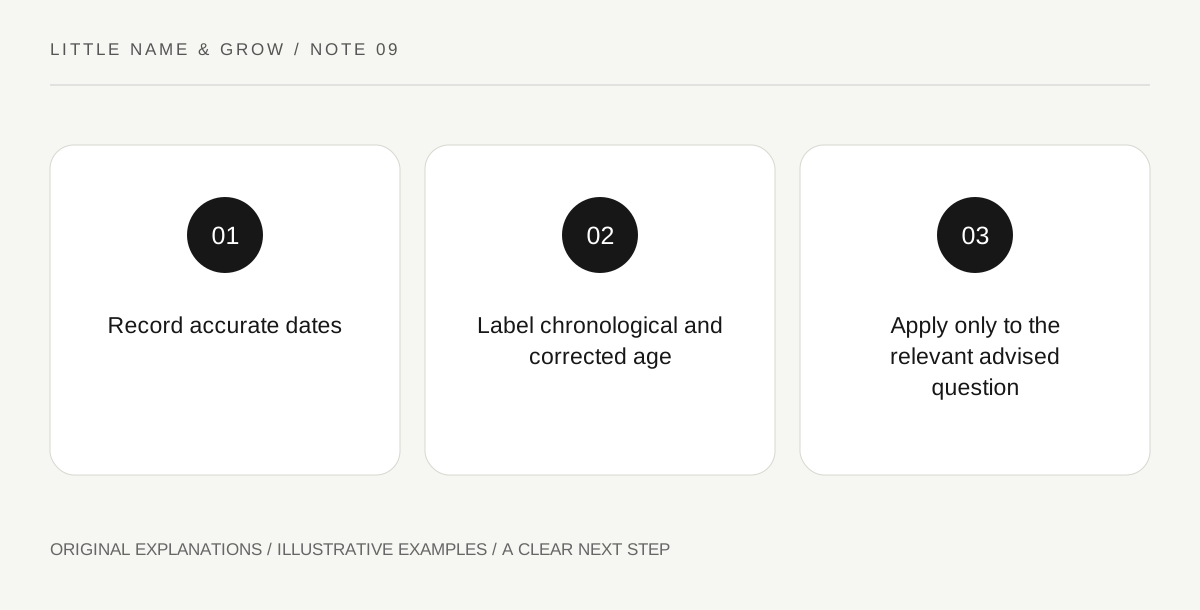
Original explanatory diagram. Read the full method and limitations below.
Keep the underlying dates accurate
Record the birth date and the due-date or gestational information provided by the care team. Ask them to explain the corrected-age calculation for your baby. AAP discusses corrected age in developmental expectations after prematurity, particularly during the early years. Do not reconstruct clinical dates from a vague family recollection if records are available. A clear note can show chronological age and corrected age separately, each labeled. The purpose is reducing confusion, not deciding that one is the baby's true age and the other can be discarded from all care conversations.
If you use an app, check which age it displays and whether an adjustment was entered deliberately or generated automatically. Keep that software choice separate from the care team's advice. A screen can make an age convention look authoritative even when it is simply a setting. If a service's form has no suitable field, ask how to provide context rather than changing the baby's birth date to make the display align.
Ask which age the question uses
Developmental expectations, appointments, immunization and other care decisions do not automatically use one age convention in the same way. Follow the care team's instructions and ask when the basis is unclear. Do not shift a medical schedule or feeding plan because an app displays a corrected age. A general article cannot apply the baby's clinical history to every decision. Keep the specific question attached to the answer: which age should we use for this developmental checklist is more useful than asking whether corrected age replaces everything. Written clarification can help different caregivers use the same information accurately.
Describe development with context rather than comparisons
Bring observations of play, communication and movement along with both labeled ages when relevant. AAP's corrected-age guidance helps explain why comparing only calendar birthdays can be misleading. It does not guarantee that every concern is explained by prematurity or that every child follows the same path. Discuss persistent concerns and lost skills with the care team. Avoid using corrected age to dismiss a worry without assessment, or chronological age to pressure the baby into a skill. The useful account describes the baby's actual experience rather than assigning a rank against peers.
Make the note usable across services
When completing a form, follow the service's instructions and ask how corrected age should be recorded if relevant. Keep official identity information separate from a developmental annotation. Tell a new professional about prematurity and the care plan rather than assuming their software automatically adjusts the display. Update the note as the care team advises. The useful outcome is clearer communication across family and services, with the limits of each age measure understood. It is not a promise of catch-up by a fixed date or permission to replace individualized follow-up with an age calculator.
An illustrative two-age note
A parent keeps the baby's birth date and clinician-explained corrected age in separate labeled fields. Before using a developmental checklist, they ask which age to apply. They do not move a vaccine appointment or change feeding instructions based on the checklist's age display.
Practical checks
Optional checkboxes save only in this browser.
Questions that come up
Does corrected age replace the birth date?
No. It is a separate developmental context, not a replacement for official identity or every medical schedule.
Can prematurity explain away every concern?
No. Discuss concerns and loss of skills with the care team rather than assuming one age adjustment settles the question.
References and scope
These sources support the factual background. Examples and exercises are original illustrative teaching material. References do not imply endorsement.
- AAP: Corrected Age for Preemies — Chronological and corrected age in development discussions after premature birth.
- CDC: Developmental Monitoring and Screening — Everyday monitoring differs from standardized screening and diagnostic assessment.