Treat a newborn hearing-screen result as a next-step instruction
A hearing screen is designed to identify babies who need further assessment, not to provide every answer about hearing. A useful response records the actual result and follows the recommended next step promptly. A baby reacting to a loud sound at home does not replace that follow-up or settle the meaning of the screen.
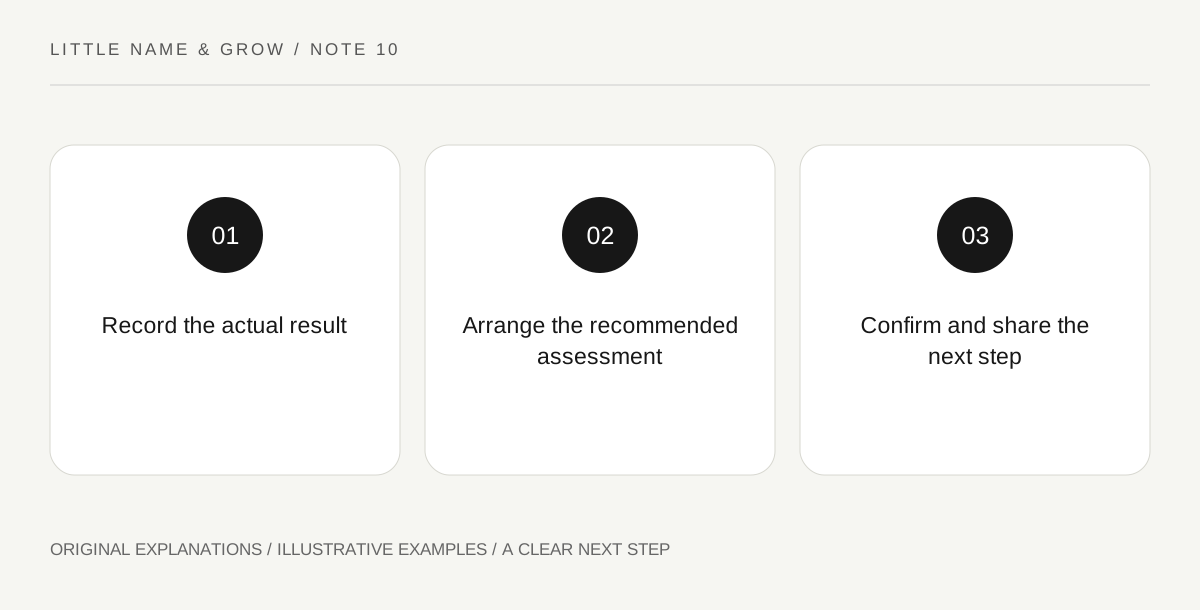
Original explanatory diagram. Read the full method and limitations below.
Keep the result's exact wording
Ask for the written result and whether it applies to both ears. Record the screening date, method if supplied and the follow-up instructions. NIDCD explains why early screening and appropriate next steps matter. Do not translate did not pass into a confirmed permanent hearing diagnosis, or pass into a guarantee that no future hearing concern can arise. If the result is unclear or missing, contact the service that performed the screen. A family recollection that someone said it was fine is not as useful as the actual documented result and plan.
Arrange the recommended follow-up
Ask who makes the appointment, where it occurs and what timing is recommended for your baby. Follow the current professional guidance rather than delaying to see whether the baby responds at home. Keep contact details and any preparation instructions accessible. If transport, cost, language or another access issue could prevent attendance, raise it early and ask for assistance. A missed appointment needs a new appropriate arrangement, not an assumption that the concern has resolved. The screening service or pediatric clinician can help clarify the route. This guide does not select a test or interpret an individual audiology result.
Ask how the assessment service will communicate a cancellation or changed appointment. Keep a reliable route to reschedule rather than letting an unanswered message end the process. If several adults help, assign one person to confirm that the next step occurred. The purpose is closing an actual follow-up task, not creating a large tracking system. A concise current note can prevent the family from assuming that another person already arranged it.
Avoid loud home tests
Do not clap loudly near the baby's ears, increase device volume or create a startling noise to prove hearing. A reaction can depend on several factors and does not measure hearing in a diagnostic way. Ordinary observations are still worth describing to the clinician, especially concerns about responses or communication. Keep the environment comfortable and protect hearing from harmful sound. A successful reaction should not be used to cancel recommended assessment. Likewise, a quiet response in one moment does not establish a diagnosis. Professional testing has a different purpose and method from a household experiment.
Close the follow-up loop
After assessment, ask what the result means, whether another step is needed and how to obtain the written report. Share relevant information with the baby's care team through appropriate routes. Keep uncertainty visible if an appointment or result remains outstanding. If new concerns arise later, seek advice even after an earlier reassuring screen. The useful outcome is a completed pathway with understandable next steps, not a one-time label that ends every future question. Families can support communication while assessment proceeds without making promises about the result or waiting for a baby to prove the need for help.
An illustrative screen follow-up
A newborn's report recommends further hearing assessment. The parents keep the exact wording and arrange the advised appointment, asking about language support. They do not cancel because the baby startles during an ordinary household sound, and they avoid deliberately creating loud noises to test hearing.
Practical checks
Optional checkboxes save only in this browser.
Questions that come up
Does not passing a screen confirm permanent hearing loss?
No. Further assessment is needed to understand the result. Follow the recommended pathway.
Can a startle at home replace follow-up?
No. An ordinary reaction does not provide a diagnostic hearing assessment or overrule the screening instructions.
References and scope
These sources support the factual background. Examples and exercises are original illustrative teaching material. References do not imply endorsement.
- NIDCD: Baby Hearing Screening and Next Steps — Screening results and timely professional follow-up.