Make a care goodbye predictable without promising there will be no tears
A care transition can be hard even when the incoming caregiver is trusted and prepared. A useful goodbye is clear, appropriate to the baby's stage and connected to a reliable handover. The aim is predictability and safe care, not eliminating every protest or using a single reaction to judge the relationship.
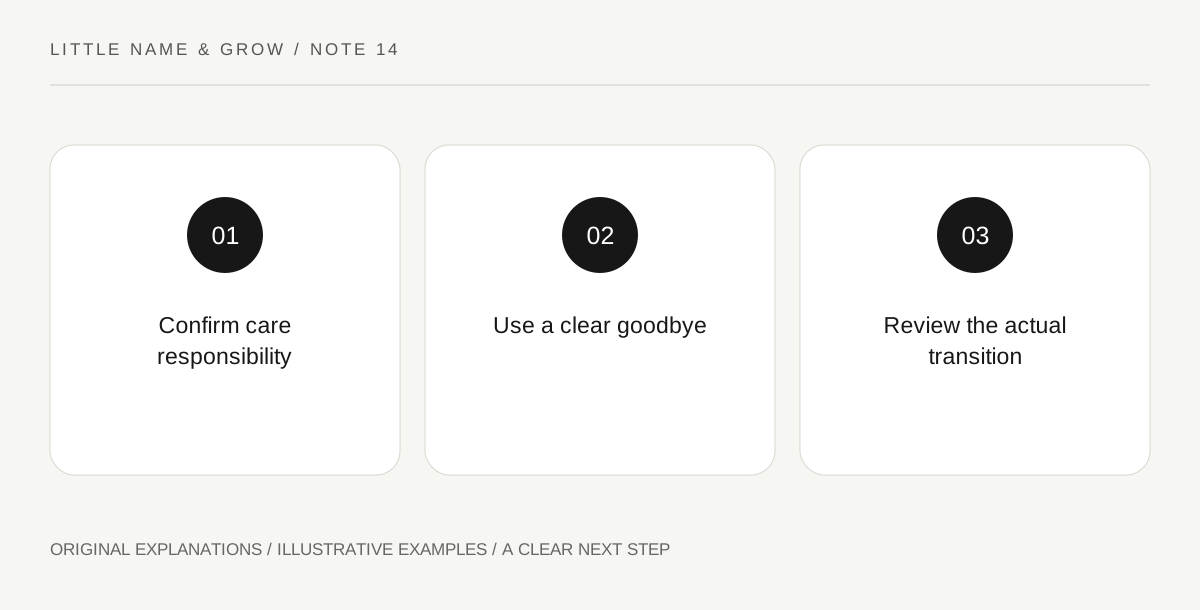
Original explanatory diagram. Read the full method and limitations below.
Separate the care arrangement from the goodbye ritual
Confirm that the incoming caregiver is authorized, capable and understands current instructions before considering the social moment. A pleasant goodbye cannot compensate for missing care information. AAP discusses separation-related responses in infancy, while individual patterns vary. This article does not prescribe sleep training or a universal separation schedule. If the baby has health or developmental needs affecting a transition, ask the relevant care team. Keep the essential arrangement concrete: who is responsible, where care occurs and how contact works. The ritual is a small part of that system, not the entire safety plan.
Use a simple consistent signal
Choose ordinary words and a brief familiar action that fit the family and setting. The phrase does not need to explain adult time concepts in detail or guarantee the baby understands when you return. Avoid promising a precise event that may not occur. A consistent goodbye can be clearer than repeatedly starting to leave and returning without a plan. Coordinate with the incoming caregiver rather than improvising while both adults are distracted. Keep the baby's comfort and care needs visible. The goal is a recognizable transition, not a performance that must produce silence before the departing adult is allowed to go.
Agree what information a settling update will contain. A useful report might describe whether the baby needed a familiar care task and how the transition proceeded, rather than a label such as cried all morning or perfectly fine without context. Follow the service's communication process and avoid requiring constant messages that interfere with care. The update should support understanding and appropriate action, not become a continuous reassurance test.
Let the incoming caregiver respond appropriately
After a clear handover, the responsible adult can use familiar suitable care and interaction. Avoid treating distress as a contest over who is preferred. The departing caregiver can follow the agreed contact route rather than repeatedly interrupting the transition to seek reassurance. At the same time, do not ignore a genuine care concern or an arrangement that is not working safely. Ask the service or professional about appropriate support when distress is persistent or significant. A goodbye method is not a diagnosis, and the presence or absence of tears does not establish the quality of attachment or the whole care setting.
Review the pattern with useful information
Ask how the baby settled, what care was needed and whether the handover information was sufficient. Keep observations specific rather than asking only whether the baby was good. Adjust practical barriers such as timing or an unclear instruction. If concerns continue, seek appropriate professional guidance rather than escalating a goodbye ritual indefinitely. A transition may remain emotional while becoming more understandable. The useful outcome is reliable care and a clear process, with room for the baby's changing responses. It does not require a no-tears guarantee or a comparison with another child's arrival video.
An illustrative daycare handover
Parents and an authorized care provider confirm current instructions and choose a simple goodbye phrase. They use the agreed contact route and later discuss settling and practical needs with specific observations. They do not treat a tearful morning as proof that the care arrangement is wrong or a quiet morning as proof that every need is met.
Practical checks
Optional checkboxes save only in this browser.
Questions that come up
Does crying prove the transition is harmful?
A single response does not settle that question. Consider the full care arrangement and seek guidance for persistent or concerning distress.
Is the goal always zero tears?
No. The aim is predictable, safe and responsive care, not a guaranteed emotional response.
References and scope
These sources support the factual background. Examples and exercises are original illustrative teaching material. References do not imply endorsement.
- AAP: Emotional and Social Development, Eight to Twelve Months — Unfamiliar people and separation can affect babies' responses.