When crying overwhelms the adult, make the next action safe
Persistent crying can overwhelm a tired caregiver even when they care deeply about the baby. The next action should protect both people and make help accessible. A safe pause is different from abandoning care, and it does not require proving that every possible soothing method has been tried first.
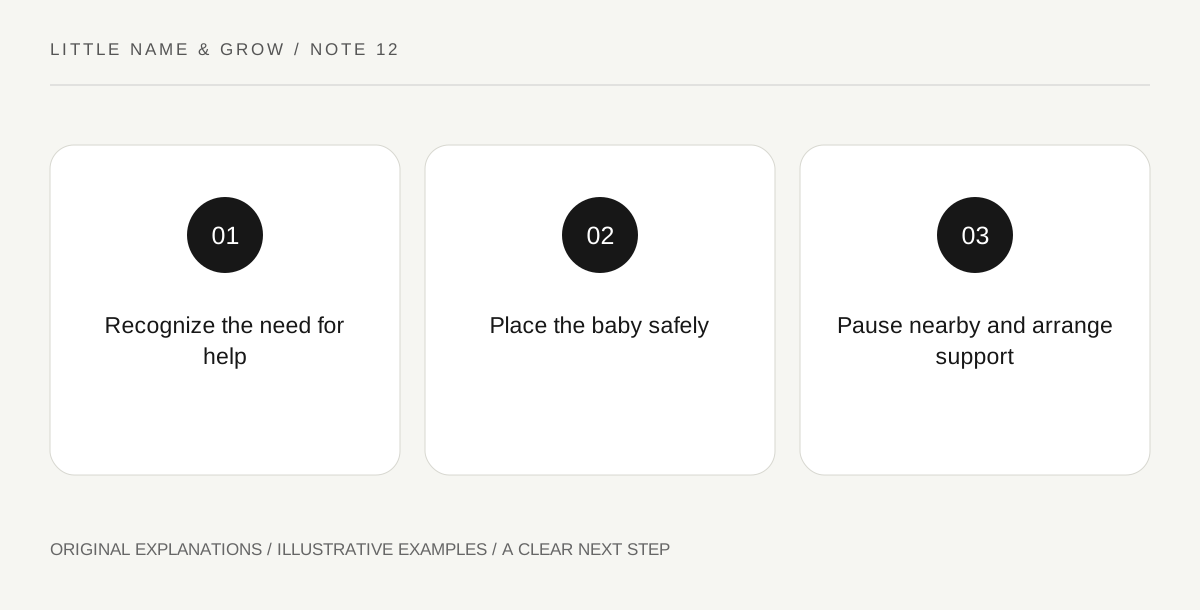
Original explanatory diagram. Read the full method and limitations below.
Check for a concerning situation
Follow the baby's care plan and seek appropriate medical advice for unusual, persistent or concerning crying or other symptoms. A general article cannot determine whether the cause is hunger, discomfort or illness. AAP advises responding to babies' cries and asking for help when needed. Do not assume that a familiar time of day proves the crying is harmless. If there is an emergency, use the relevant emergency route. The adult's distress and the baby's health question can both deserve attention. Neither should be dismissed because another caregiver says that all babies cry.
Recognize when the adult needs to stop handling
Notice the point at which frustration makes safe care difficult. Put the baby on their back in an appropriate clear, firm, flat infant sleep space according to current safe-sleep guidance, then take a brief nearby pause as AAP advises and seek support. Never shake or handle a baby roughly. Do not place the baby on a sofa, adult bed or another unsafe surface for the pause. The exact arrangement must preserve safety and the ability to check and respond. A pause is not a punishment for the baby or an invitation to leave necessary care unattended.
Ask a specific person for appropriate help
If another authorized capable caregiver is available, state what is needed: take responsibility now while I recover enough to continue safely. Confirm the handover rather than assuming a person in the room has accepted it. If no one is available, contact an appropriate support or care service. Avoid inventing a soothing remedy under pressure, especially a medicine or supplement not advised for the baby. A helper can also provide practical support such as contacting the clinician or arranging food for the adult. The goal is safe care and support, not finding the person who can prove superior soothing ability.
Plan for the next difficult period
When the moment has passed, discuss a safe response plan with trusted caregivers and the care team as appropriate. Keep contact routes accessible and agree that asking for relief is allowed before frustration escalates. Do not use a successful pause as proof that the baby's crying needs no assessment, or a hard evening as a verdict on parenting. Persistent distress in the adult deserves care too. The useful outcome is a clear safety action and an available support route. It does not require a guaranteed method to stop crying, a perfect emotional response or a comparison with another family's experience.
Place the support contact where the responsible adult can find it without searching through many messages. Agree in advance that a request for help should be taken seriously. A helper who cannot safely take over should say so and assist with another appropriate route rather than accepting responsibility on guesswork. A clear response plan protects the baby and adult without treating exhaustion as something that must be hidden.
An illustrative safe pause
After a prolonged difficult period, a caregiver realizes frustration is rising. They place the baby safely on the back in the appropriate clear infant sleep space, take a brief nearby pause and contact a trusted capable helper. They also seek the care team's advice about the crying rather than experimenting with an unverified remedy.
Practical checks
Optional checkboxes save only in this browser.
Questions that come up
Does needing a pause mean I do not care?
No. Recognizing that you need help can protect safe care. Ask for support before frustration escalates.
Can I leave the baby on an adult bed for the pause?
No. Use an appropriate infant sleep space under current safe-sleep guidance, not a sofa or adult bed.
References and scope
These sources support the factual background. Examples and exercises are original illustrative teaching material. References do not imply endorsement.
- AAP: Responding to Your Baby's Cries — Responding to crying, safe caregiver pauses and never shaking a baby.
- AAP: Back to Sleep, Tummy to Play — Supervised awake tummy play is different from the recommended sleep position.