Use the first tooth as a prompt to establish a dental care route
A first tooth brings a new care question as well as a family photograph. The ADA recommends a dental visit after the first tooth appears and no later than the first birthday. A useful preparation focuses on daily care, access and questions, without assuming that the absence of pain means no dental guidance is needed.
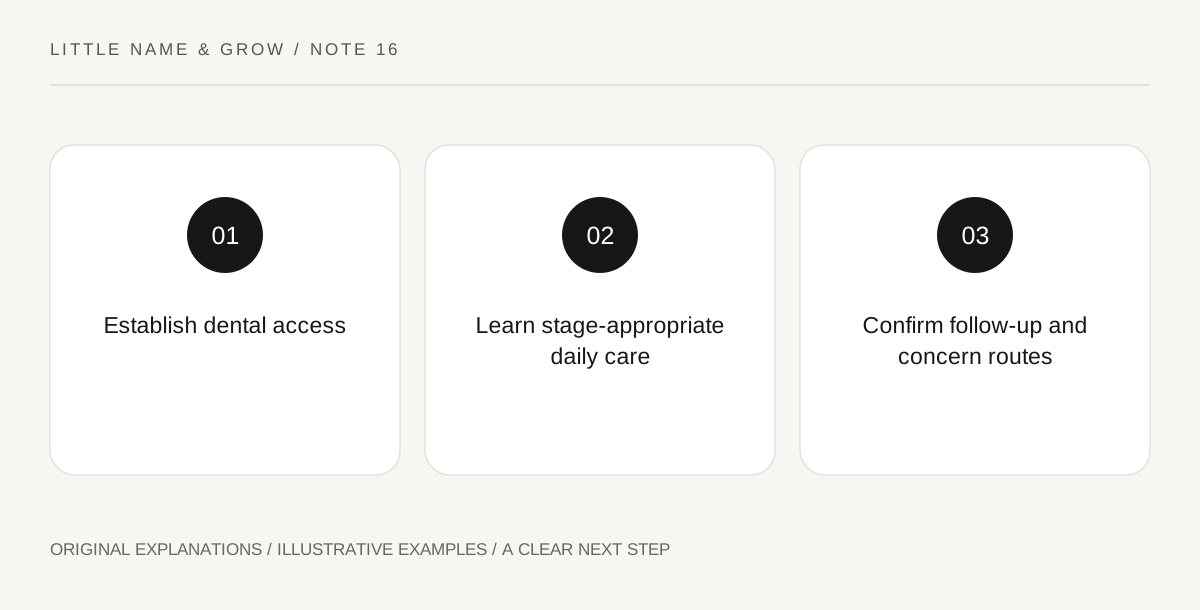
Original explanatory diagram. Read the full method and limitations below.
Find an appropriate dental service early
Ask the baby's clinician or a suitable local resource about finding dental care for an infant. Confirm the service's age range, appointment process, access and costs through reliable current information. ADA guidance gives an early-visit prompt; it does not mean waiting for a visible problem. A family history of easy teeth or an older sibling's experience does not establish this baby's needs. If a tooth or mouth concern appears before a planned visit, ask the relevant professional rather than waiting for a birthday. Keep urgent symptoms on an appropriate care route, separate from a routine booking.
Bring the actual feeding and care pattern
Describe milk feeding, any introduced foods, current cleaning and products used, without editing the account to sound ideal. Ask how daily mouth and tooth care should be performed for the baby's stage. Use the dentist's current instructions for toothpaste and technique rather than copying an older child's routine. This article does not prescribe a fluoride regimen or treatment. A product labeled for babies still needs appropriate use. Keep all medicines and relevant health needs available if requested, and mention any difficulty with handling or positioning so the professional can demonstrate a suitable method.
Ask for a demonstration you can repeat
A short explanation becomes more useful when you can show or describe how you will carry it out. Ask about the tool, amount, position and frequency appropriate to the actual advice. Clarify what to do when the baby resists and how to avoid unsafe handling. Do not force a method from an online clip or use household remedies for a sore mouth. If several adults share care, make the professional instruction accessible to them accurately. A consistent understood plan is more useful than a basket of oral-care products whose roles are unclear.
Keep follow-up tied to the baby
Before leaving, ask when the next review is appropriate and what changes need contact. Save a concise current instruction rather than a generic internet schedule. If the recommended routine is difficult, tell the dental team where it breaks down and ask for an appropriate adjustment. Do not assume that one visit or a comfortable-looking mouth ends the need for care. The useful outcome is a reliable service and a daily method you understand. It does not require a perfectly cooperative baby, a guaranteed cavity-free future or a claim that a particular brush has been tested by this website.
Ask the dental service how to prepare for the visit in a way that fits a baby's routine. Appointment timing, language access and a caregiver's ability to understand instructions can affect the experience. Do not promise that the baby will cooperate or apologize for ordinary infant behavior. The professional visit should provide a route to appropriate care even when the demonstration needs adapting or another explanation.
An illustrative first-tooth call
After noticing a first tooth, parents contact an appropriate infant dental service instead of waiting for pain. They bring their actual feeding and cleaning questions and ask for a demonstration. They leave with a clear current care plan and review route, not an unverified product bundle or a copied older-child routine.
Practical checks
Optional checkboxes save only in this browser.
Questions that come up
Should I wait for all baby teeth before a visit?
No. ADA recommends a visit after the first tooth appears and no later than the first birthday.
Can I copy an older child's toothpaste routine?
Ask the dental professional about the baby's stage and appropriate product use rather than assuming the same instructions apply.
References and scope
These sources support the factual background. Examples and exercises are original illustrative teaching material. References do not imply endorsement.
- ADA: Baby's First Dental Visit — Dental visit after the first tooth and no later than the first birthday.