Keep awake tummy play distinct from sleep and from an endurance challenge
Tummy play is an awake, supervised activity with a different purpose from sleep. A useful plan makes the adult's attention and the baby's comfort explicit. It does not require a baby to tolerate a fixed challenge, and babies born prematurely or with relevant health needs may need individualized guidance.
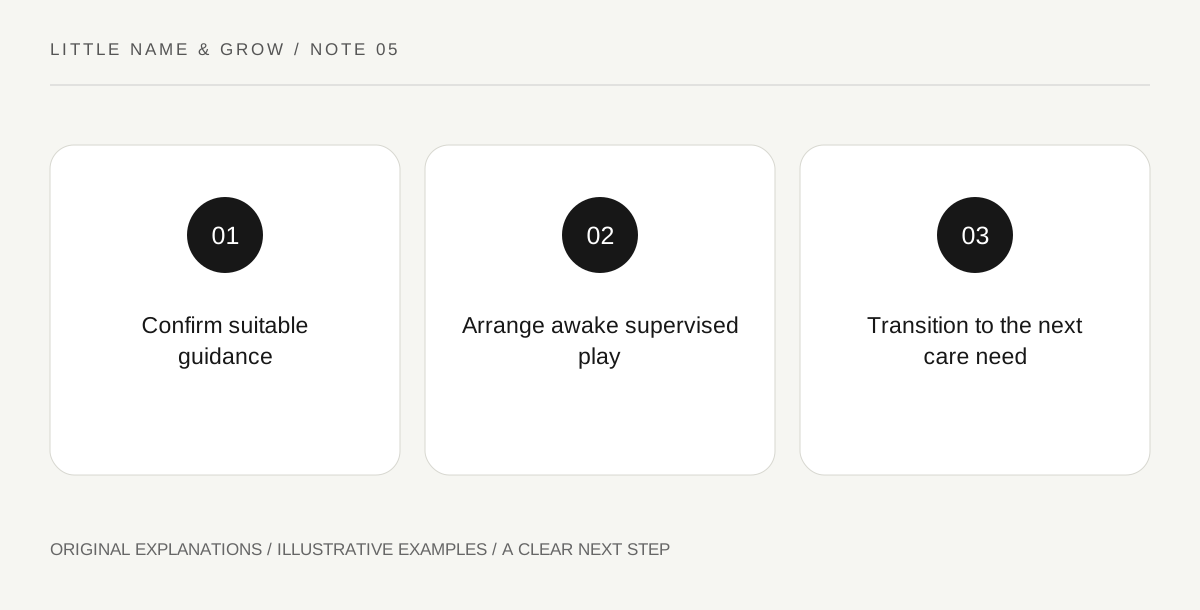
Original explanatory diagram. Read the full method and limitations below.
Confirm the baby's situation and guidance
Use current pediatric advice and ask the care team about prematurity, reflux, medical needs or other circumstances affecting tummy play. AAP distinguishes supervised awake tummy time from back sleeping. This article does not prescribe a universal starting schedule or substitute for a clinician's instructions. Choose a moment when the baby is awake and the adult can actively watch. A play recommendation is not permission to leave a baby prone for sleep. Keep that distinction clear for every caregiver, because a product photograph or a casual phrase such as strengthening position can blur two very different situations.
Ask what signs should lead you to pause and whom to contact if the activity remains difficult. A demonstration from the care team can be more useful than comparing online schedules. Keep the explanation specific to awake play. If a relative remembers a different sleep recommendation, direct the discussion to current professional guidance rather than treating family familiarity as a reason to blur play and sleep positions.
Choose an appropriate supervised setup
Follow the care guidance for a suitable surface and position, keeping the area clear of hazards and unnecessary objects. Do not improvise with pillows, soft sleep surfaces or positioning products to make the baby stay in place. The adult should be close enough to observe and respond appropriately, without a phone or another task taking over attention. Ask a clinician to demonstrate a suitable option if you are unsure. A photograph cannot show all support and supervision details. The useful setup is one the responsible adult understands, rather than one that looks like an ideal developmental activity online.
Use interaction rather than a performance target
A familiar face or voice can make the awake moment engaging. Follow the baby's response and the relevant guidance rather than demanding a particular head lift for a camera. Do not press, stretch or position limbs to accelerate a skill. If the baby is distressed or the activity is not going well, stop and ask for advice when needed. A timer can help an adult remember a plan recommended to them, but it does not authorize pushing through discomfort. The goal is an appropriate opportunity for movement, not comparing endurance with another baby's edited clip.
End the activity with the next care need
When the baby needs feeding, rest or another care task, transition appropriately. For sleep, use the recommended safe sleep arrangement and position under current guidance, separate from the play setup. Keep a simple account of what was comfortable if discussing the activity with the clinician. Avoid interpreting one short attempt as proof of delay or one strong movement as a guarantee of future development. If there are concerns about movement or loss of skills, seek assessment. The useful outcome is a clear distinction between awake play, sleep and individual care, with room to adjust the activity appropriately.
An illustrative awake-play check
A caregiver asks the pediatrician how tummy play fits a baby's specific care needs. At home they choose an awake supervised moment and stop when the baby needs another care task. They return to the separate safe sleep arrangement when needed rather than treating the play position as a sleep recommendation.
Practical checks
Optional checkboxes save only in this browser.
Questions that come up
Does tummy play change the recommended sleep position?
No. Awake supervised play and safe sleep are different situations. Follow current safe-sleep guidance.
Should I force a target duration despite distress?
No. Follow appropriate guidance and ask the care team about difficulty rather than turning it into an endurance challenge.
References and scope
These sources support the factual background. Examples and exercises are original illustrative teaching material. References do not imply endorsement.
- AAP: Back to Sleep, Tummy to Play — Supervised awake tummy play is different from the recommended sleep position.